English Foxhound Puppies: Development Stages and Care

English Foxhound puppies are energetic, scent-driven pack hounds, not low-effort lap dogs. They grow through the same broad stages as other puppies—newborn, transitional, socialization, juvenile, and adolescent—but their breed history matters: they were developed to follow scent for long periods and work alongside other hounds. That means a puppy needs secure containment, plenty of appropriate exercise, early reward-based training, and thoughtful socialization.
The timeline below is a guide, not a strict schedule. Puppies vary by individual, and a veterinarian or reputable breeder can help you judge whether a particular puppy is growing and behaving appropriately.
English Foxhound puppy development at a glance
- Newborn and neonatal: birth to about 2 weeks
- Transitional: about 2 to 4 weeks
- Socialization: about 4 to 12–16 weeks
- Juvenile: about 3 to 6 months
- Adolescent: about 6 to 12–18 months, with behavioral maturity often later
Newborn and neonatal stage (birth to about 2 weeks)
Newborn English Foxhound puppies are blind and deaf at birth, with eyes and ear canals closed. They depend on their mother for warmth, food, and cleaning, and they cannot regulate body temperature well. At this age, puppies mostly sleep, crawl, and nurse. They can taste and respond to touch and scent, but their world is very limited.
Eyes usually begin to open at around 10 to 14 days, and the ear canals begin to open at roughly the same time. The eyes may look blue or cloudy at first, and vision is not clear. Do not force the eyes open or expose young puppies to bright light or crowded environments.

Transitional stage (about 2 to 4 weeks)
During the transitional stage, puppies’ eyes open wider, hearing develops, and they begin to take cautious steps instead of crawling. They start interacting more with littermates and exploring their immediate surroundings. This is a sensitive period for early neurological and sensory development, but puppies still need a warm, clean, low-stress environment and close supervision with their mother.
Socialization stage (about 4 to 12–16 weeks)
Socialization is the process of exposing a puppy to everyday sights, sounds, surfaces, people, and other animals in ways that are positive and not overwhelming. The period from roughly 4 to 12 weeks—sometimes extended to 16 weeks—is often called the critical socialization window. Experiences during this time can shape how confident or fearful a dog is later, though socialization should continue throughout life.
For an English Foxhound puppy, socialization should include gentle handling, household noises, different floor surfaces, car travel, visitors, and calm encounters with vaccinated, healthy dogs when your veterinarian says it is safe. Avoid dog parks, unknown dogs, and areas with unknown vaccination status until your puppy’s vaccine schedule is further along. A well-run puppy class that checks vaccination status and uses reward-based methods can be useful.
Pair new experiences with treats, praise, and play. If a puppy freezes, hides, barks, or tries to escape, the experience is too intense; increase distance and go more slowly. Do not flood a puppy with things that frighten it.
Juvenile stage (about 3 to 6 months)
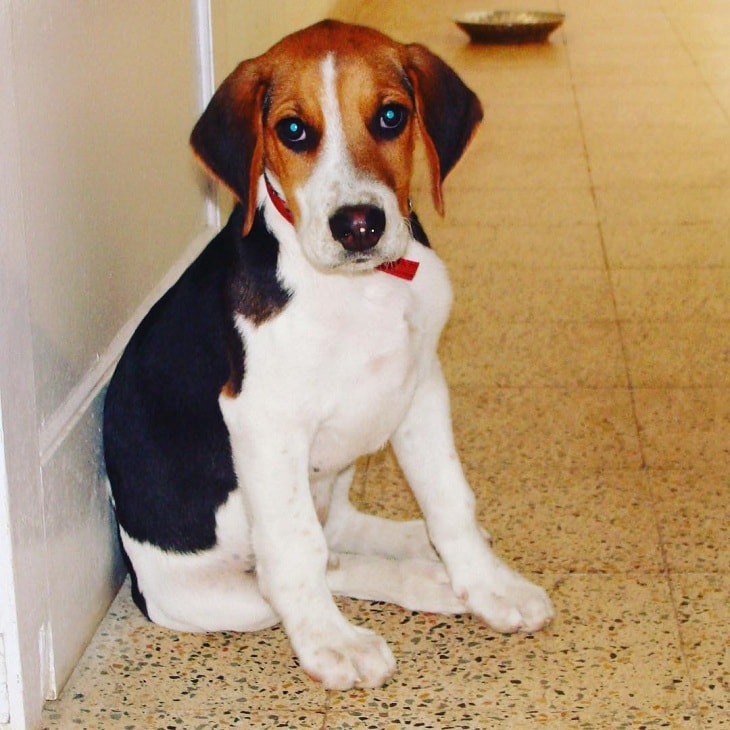
By the juvenile stage, English Foxhound puppies are more confident, mobile, and curious. They may seem to have endless energy, and their scent-driven nature becomes more obvious. This is also when puppy teeth are replaced by adult teeth, so chewing and mouthing often increase.
Common changes include:
- More chewing and mouthing, especially during teething. Offer safe chew toys and redirect nipping toward appropriate items.
- Greater independence and exploration. A secure yard, leash walks, and scent games help channel this safely.
- Testing boundaries. This is normal puppy behavior, not a sign that the puppy is trying to become the alpha.
- Need for short, consistent training sessions. English Foxhounds can be independent and easily distracted by scent, so reward-based training works better than harsh corrections.
This is a good time to practice name recognition, recall, loose-leash walking, settling, and handling. Keep training positive and brief, and use high-value treats in low-distraction settings before adding difficulty.
Adolescent stage (about 6 to 12–18 months)
Adolescence brings physical and hormonal changes. Sexual maturity can begin around 6 to 12 months, depending on the individual, but social and behavioral maturity usually takes longer. A one-year-old English Foxhound may look grown up but still behave like a teenager. Large breeds and scent hounds can continue maturing well beyond their first birthday.
Adolescent English Foxhounds may become more interested in scent, more independent, and less immediately responsive to cues. They may also test household rules. This is not dominance; it is a normal developmental stage. Continue reward-based training, increase supervised exercise and mental work, and use a long line or secure enclosed area for practice rather than assuming the puppy will reliably return off-leash.
Do not expect obedience to be finished by this age. Training is an ongoing process, and consistency matters more than intensity. If training or behavior problems feel unmanageable, seek help from a qualified reward-based trainer or veterinary behaviorist rather than using punishment.
Practical care for an English Foxhound puppy
English Foxhounds are athletic, social dogs bred to work in packs. They generally need more daily exercise and mental stimulation than many companion breeds. Daily walks, scent games, safe play, and training can help, but exercise should be appropriate for the puppy’s age and growth. Avoid repetitive high-impact exercise and long forced runs while the puppy is still growing, especially on hard surfaces.
A secure fence is important. Scent hounds may follow a trail and ignore calls, so an open yard is not enough for off-leash safety. Check fences for gaps, and supervise outdoor time. Because English Foxhounds are vocal and can bay, also consider how your home and neighbors will cope with normal hound noise.
Feeding should be based on a complete and balanced puppy diet appropriate for the dog’s expected adult size, with portion guidance from the food label or your veterinarian. Fresh water should be available at all times. Grooming needs are modest: regular brushing, nail trims, ear checks, and dental care help prevent common problems. Ask your veterinarian about vaccination, parasite prevention, microchipping, and the right time to discuss neutering.
When to call a veterinarian
Puppies can deteriorate quickly. Contact a veterinarian promptly if an English Foxhound puppy is not eating or drinking, has repeated vomiting or diarrhea, seems lethargic or weak, cries persistently, has pale gums, has difficulty breathing, has a swollen abdomen, has a seizure, or shows signs of pain or injury. Diarrhea or vomiting in a young puppy is not something to wait out. Also ask your vet about any lumps, rashes, lameness, or eye or ear discharge, and follow your puppy’s vaccination schedule.
This information is general education, not a diagnosis or treatment plan. A veterinarian who examines your puppy should make individual health and nutrition decisions.
Common questions about English Foxhound puppies
Are English Foxhound puppies hard to train?
They can be challenging in a specific way: they are intelligent but often independent and strongly led by scent. Short, reward-based sessions, consistency, and practice in gradually more distracting places work better than repetitive drilling or punishment. Recall and off-leash reliability need special attention.
Do English Foxhound puppies need a lot of exercise?
They are active dogs, but puppies should not be overexercised during growth. Several short walks, supervised play, and mental enrichment are usually more appropriate than long forced runs. Your veterinarian can help you adjust exercise as the puppy grows.
Can English Foxhound puppies live in apartments?
They can live in smaller homes if their exercise and mental needs are met, but their size, energy, and tendency to bay can make apartment life difficult. Shared walls and close neighbors may be a practical concern. Secure outdoor access or reliable daily exercise is important.
For more dog breed information and puppy growth charts, visit Doglime.