Entlebucher Mountain Puppies: Growth Stages From Birth to Adulthood

Entlebucher Mountain puppies go from blind, helpless newborns to busy, confident young dogs in less than a year. Knowing what happens at each stage makes those months far easier to manage, because you can tell what is normal, what needs training, and what is worth a call to the vet.
The Entlebucher (Entlebucher Sennenhund) is the smallest of the four Swiss mountain dog breeds: a compact, muscular drover’s dog bred to move cattle on Alpine pastures. That history shows up early. These puppies tend to be bold, energetic and mouthy rather than delicate, and they do best with patient, reward-based training from the day they come home.
Newborn and neonatal stage (birth to 2 weeks)
Entlebucher puppies are born blind, deaf and toothless. They cannot control their own body temperature for the first couple of weeks, so they rely on their mother and littermates for warmth and on touch and smell to find a nipple and feed. Your job at this age is mostly housekeeping: keep the whelping box clean, warm and quiet, and handle the puppies only briefly so the mother stays settled.
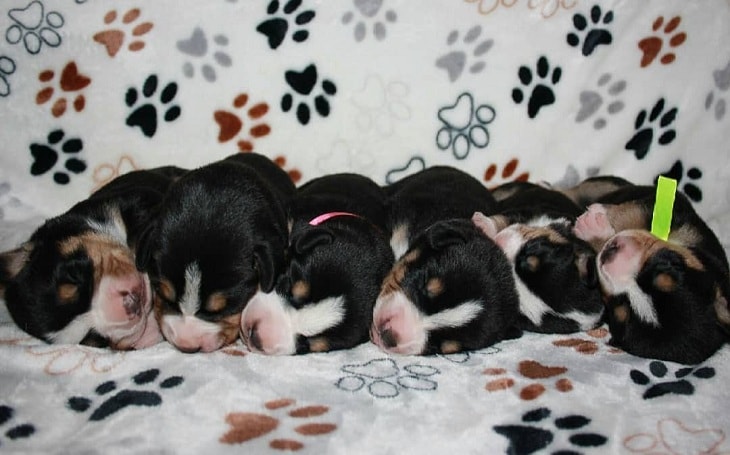
The immune protection a puppy receives in its first days comes from colostrum, the antibody-rich first milk. Those are antibodies, not antibiotics. A puppy that misses out on colostrum is more vulnerable to infection and should be checked by a veterinarian. That borrowed protection fades over the following weeks, which is why vaccinations are timed to take over — ask your vet for a schedule suited to your area.
Newborns sleep for the large majority of the day, often close to 90% of it, and wake mainly to feed. A puppy that cries almost constantly, feels cold to the touch or is not gaining weight needs veterinary attention quickly.
Transitional stage (about 2 to 4 weeks)
Between roughly 10 and 15 days the eyes begin to open, and the ear canals open around the same time. Puppies usually manage to stand at around two and a half weeks and take their first unsteady steps by about three weeks. Timings vary a little from litter to litter, and vision is poor at first — open eyes do not mean clear sight.
Teeth start coming through during this stage and the mother begins to nurse less often. Most litters move towards softened food at the end of this window, with weaning continuing over the following weeks. It is also a good time to begin short, calm handling: gentle weight checks, a few different floor surfaces, ordinary household sounds, and being picked up and put down without drama.
Socialisation window (about 4 to 12–16 weeks)
This is the period that shapes most of the adult dog’s temperament. Puppies usually leave for their new home at around eight weeks, by which point they are eating solid puppy food and no longer nursing. Most behaviourists describe a sensitive period running from roughly three weeks to somewhere between 12 and 16 weeks, when new experiences are absorbed with comparatively little fear.
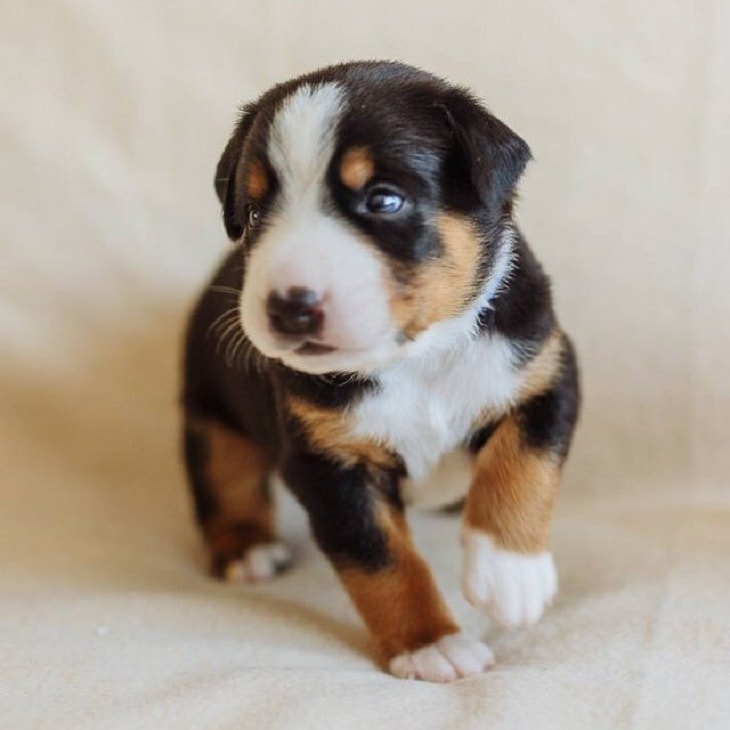
What happens during that window — the people met, the floors walked on, the noises heard, the handling accepted — has a lasting effect on how bold or fearful an Entlebucher turns out. That is not because a puppy permanently decides who counts as family, but because early positive exposure builds resilience while frightening experiences can leave a mark. Keep introductions calm and gradual, and let the puppy retreat when it wants to.
Formal training can start the day your puppy comes home. Short, cheerful sessions on name recognition, coming when called and settling on a mat are enough. There is no developmental milestone you need to wait for, and the most receptive weeks are too valuable to spend waiting.
Socialising safely before vaccinations are complete
There is a real trade-off here. Puppies need experiences before their vaccination course finishes, but they are also vulnerable to infectious disease. A practical middle ground is to carry your puppy through busy places rather than let it walk everywhere, invite calm, healthy, vaccinated adult dogs into your own yard, avoid unknown dogs and dog parks, and ask your vet what is reasonable where you live.
Mouthing and heel-nipping
Entlebuchers were bred to drive cattle, and many puppies use their mouths the way a working dog would — grabbing trouser legs and nipping at the heels of running children. It is normal puppy behaviour, not aggression, but it needs steering. Redirect the puppy onto a toy, reward it for chewing the right thing, and pause play briefly when teeth touch skin so the puppy learns that biting ends the fun. Harsh physical corrections tend to make a confident herding breed more defensive, not more cooperative.
Supervise young children around any puppy, no matter how gentle it seems, and teach children not to run or shriek near a puppy that is already excited.
Juvenile stage (about 3 to 6 months)
Confidence climbs steadily now, and the puppy becomes far more interested in the world than in you. This is the age many owners describe as the start of pre-adolescence: bolder, faster, and suddenly selective about coming when called.
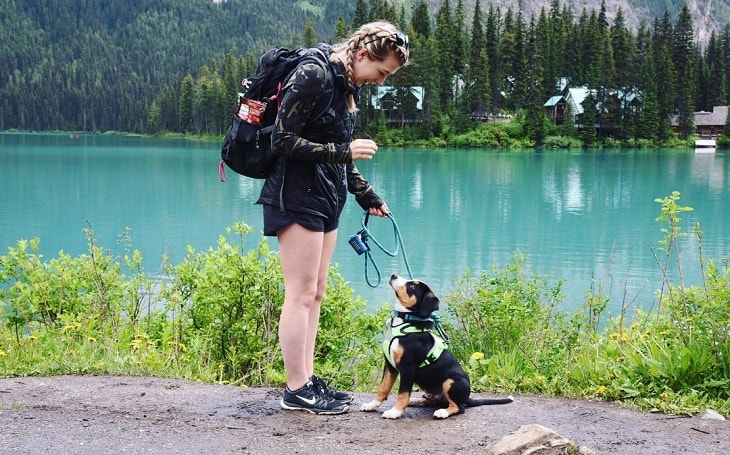
Chewing is at its peak because the adult teeth arrive roughly between four and seven months. Shoes, chair legs and hands all become targets. Manage it rather than fight it: put tempting items out of reach, supervise closely, and keep a good supply of appropriate chews and food-stuffed toys available so the puppy has a legal outlet.
A juvenile Entlebucher who ignores you, jumps up or grabs the lead is not trying to become the ‘alpha dog’. Behaviour that gets rewarded repeats, and behaviour that is ignored or redirected fades. Decide what you want instead — four paws on the floor, a sit before the door opens, a toy instead of a sleeve — reward it consistently, and make sure everyone in the household follows the same rules.
Keep training sessions short, frequent and rewarding; five or ten minutes two or three times a day teaches more than one long session. Enrol in a good puppy class if you can, both for the training and for controlled experience around other people and dogs.
Adolescent stage (about 6 months to 1–2 years)
Puberty usually arrives somewhere between six and nine months. Hormonal changes, a growing body and a brain that is still developing all contribute to the behaviour many owners find frustrating: the recall that worked last month suddenly does not, the lead walking falls apart, and the dog seems to forget everything it knew.
Learning has not stopped, and neither has brain development — the idea that a dog’s mind is ‘finished’ at a set age is misleading. What changes is that the dog is more easily distracted, more motivated by other dogs and smells, and less eager to comply. Training regression at this age is normal. Go back to shorter distances, higher-value rewards and more repetition rather than assuming the dog has become stubborn.
Diet is worth a separate note. Puppies are eating solid food long before adolescence; the transition that happens around this age is from puppy food to adult food. Many medium-sized dogs make that switch at roughly 10 to 12 months, once growth has largely finished, but the right timing depends on your dog’s size, body condition and food — confirm it with your vet rather than following a fixed calendar.
An adolescent Entlebucher also needs a proper outlet for its working heritage. Daily walks alone are rarely enough for a drover breed; add sniffing games, trick training, retrieve games or a canine sport, and give the dog a job to do with its nose and brain as well as its legs. Under-exercised, under-stimulated herding dogs invent their own entertainment, which usually involves barking, digging or chasing.
Fear periods can appear during adolescence too, with a previously confident dog suddenly wary of something ordinary. Respond by staying calm and giving the dog space rather than forcing an interaction, and reward any brave curiosity.
Finally, ask any breeder about health testing of the parents. Hip screening is commonly carried out in the Swiss mountain dog breeds, and eye examinations are also worth asking about. A responsible breeder will show you results rather than simply describing the parents as healthy.
The bottom line is that raising a well-mannered Entlebucher Mountain Dog comes down to consistency rather than strictness: gentle, reward-based training, clear rules that everyone follows, plenty of exercise and mental work, and a puppy that is socialised carefully instead of overwhelmed. Individual dogs vary in temperament and pace of development, so treat the timelines above as a guide and talk to your vet about anything that seems off.
Frequently asked questions
At what age can an Entlebucher puppy leave its mother?
Around eight weeks is the widely accepted minimum. The final weeks with the mother and littermates are where puppies learn bite inhibition and social skills that are hard to teach later, so a puppy sent home at six weeks misses important lessons. Avoid breeders who offer to release puppies significantly earlier.
Do Entlebucher Mountain Dogs calm down?
They usually become steadier as they move out of adolescence, often somewhere around two years old, but they remain an active working breed. Expect a dog that still needs daily exercise and something to think about; a bored Entlebucher is not a calm one.
Are Entlebucher Mountain Dogs good with children?
Many are, particularly when raised alongside respectful children and socialised early. Their herding instinct can show up as chasing or heel-nipping when children run, and their confidence means they will not always back away. Supervise interactions, teach children how to behave around dogs, and never assume any dog is safe to leave alone with a child.
Visit Doglime for more dog breed information and their puppies.