Best Dog Food for Airedale Terriers: What to Feed Daily

Last updated: October 21, 2026
Good dog food for Airedale Terrier owners starts with one test. Is it complete and balanced for your dog’s life stage? After that, portion and routine decide the result. Brand marketing decides very little.
Airedales are big, busy terriers. They eat like athletes on active days and like couch dogs at rest. Your plan has to handle both.
Airedale Terrier nutrition needs

Start with size. The Airedale Terrier Club of America quotes the AKC breed standard on height. Dogs measure approximately 23 inches at the shoulder. Bitches measure slightly less, and both sexes should be sturdy and well muscled.
The AKC breed summary puts adult weight at 50 to 70 pounds, as listed by Showsight.
Your nutritional floor comes from the AAFCO Dog Food Nutrient Profiles. For adult maintenance, minimum crude protein is 18.0% on a dry matter basis. For growth and reproduction, the minimum is 22.5%.
Minimum crude fat is 5.5% for adults. For growth and reproduction, it is 8.5%.
Treat those figures as minimums, not targets. More protein is not automatically better. What counts is a complete recipe matched to age, condition, and workload.
VCA Hospitals notes that amount and type vary with activity levels too. So feed the dog in front of you, not the breed average.

What to look for on a dog food label
Skip the front of the bag. The useful information sits on the back:
- The nutritional adequacy statement. It should say the food is complete and balanced for a named life stage. “Intermittent or supplemental feeding only” means it is not a main diet.
- The life stage itself. Puppy, adult, and all-life-stages foods are built differently.
- Calories per cup or per kilogram. You cannot portion honestly without the energy density.
- The maker’s name and contact details. The WSAVA Global Nutrition Committee’s guidelines on selecting pet foods suggest asking who formulates the food, and about feeding trials and quality control.
Best food types for Airedales
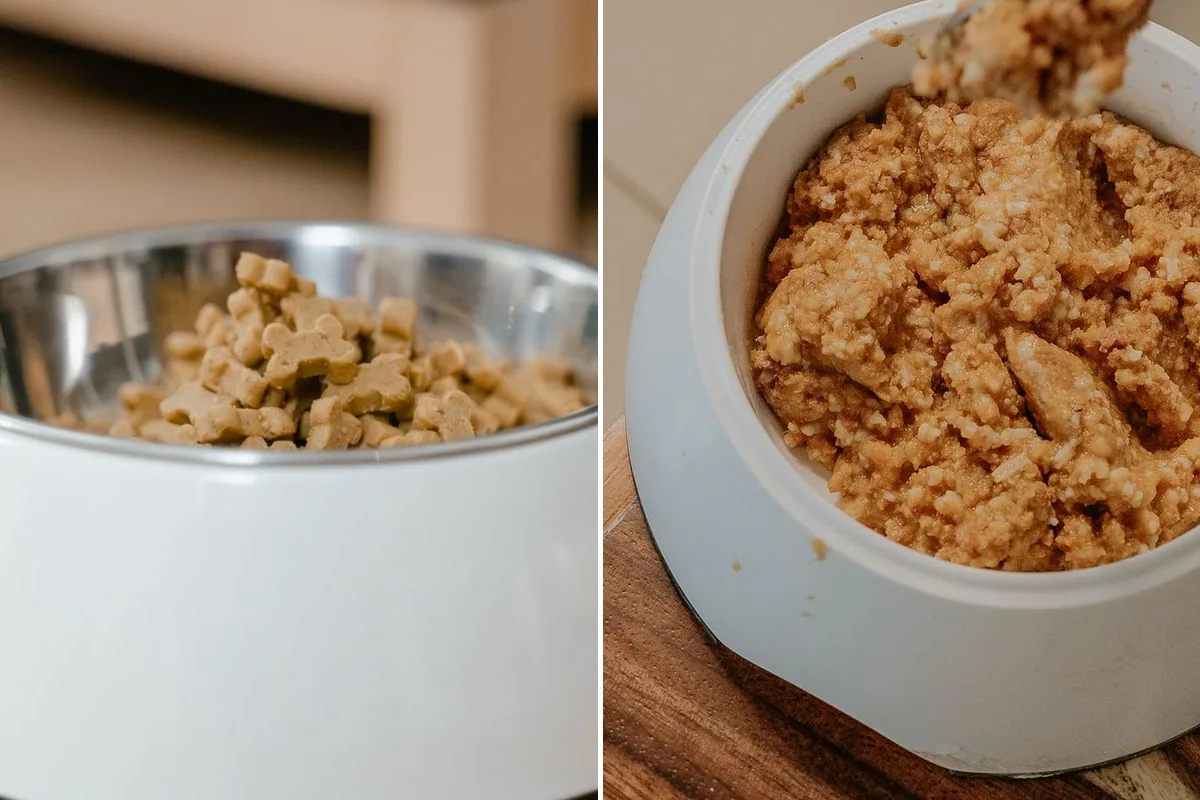
Dry, wet, and mixed feeding can all work for this breed. Format matters less than the adequacy statement and the portion.
Dry food (kibble) is easy to weigh, store, and split into set meals. That precision helps with a terrier whose weight can creep up. Weigh it, or use the same measured scoop every time.
Wet food suits dogs who drink little or eat reluctantly. It is bulkier per calorie, which can help a dog feel fed. Expect more of it in that famous beard, though.
Mixed feeding puts wet food over kibble. Many owners settle there. Just count the topper inside the day’s total, never as a free extra.
What about raw feeding? My take: skip it. VCA reports that raw diets carry well-reported food safety risks, strong evidence for benefits is lacking, and many raw diets miss essential nutrients. A complete commercial food is the safer default for most homes.
How much to feed an Airedale: judging your dog’s portion
You will not find a cup amount in this section. That is deliberate. No authoritative source publishes an Airedale-specific cup figure, and foods differ widely in calories per cup.
Here is the method the veterinary sources actually support. VCA Hospitals says package guidelines can be a starting point for a healthy dog. Your veterinary team can also do an energy calculation from weight, activity, and other factors.
Then check the dog, not just the scoop. VCA Hospitals’ overweight guide gives a simple hands-on test. You should feel the ribs easily under a slight layer of fat. From above, your dog should show a discernible, hourglass-shaped waist.
Ribs hard to find? Waist missing? The portion is too big, whatever the bag says.
Two habits protect the portion. First, measure every meal instead of eyeballing it. Second, count treats inside the day’s total.
VCA’s puppy guidance says treats should not make up over 10% of your puppy’s calories. That ceiling is a sensible adult guardrail too, though the source states it for puppies.
One rule sits under all of this: confirm portions with your veterinarian. Bag guides assume an average dog. Your Airedale’s age, weight, and workload rarely match that average.
Feeding schedule by age
Routine suits this breed. Same food, same measure, same times each day.
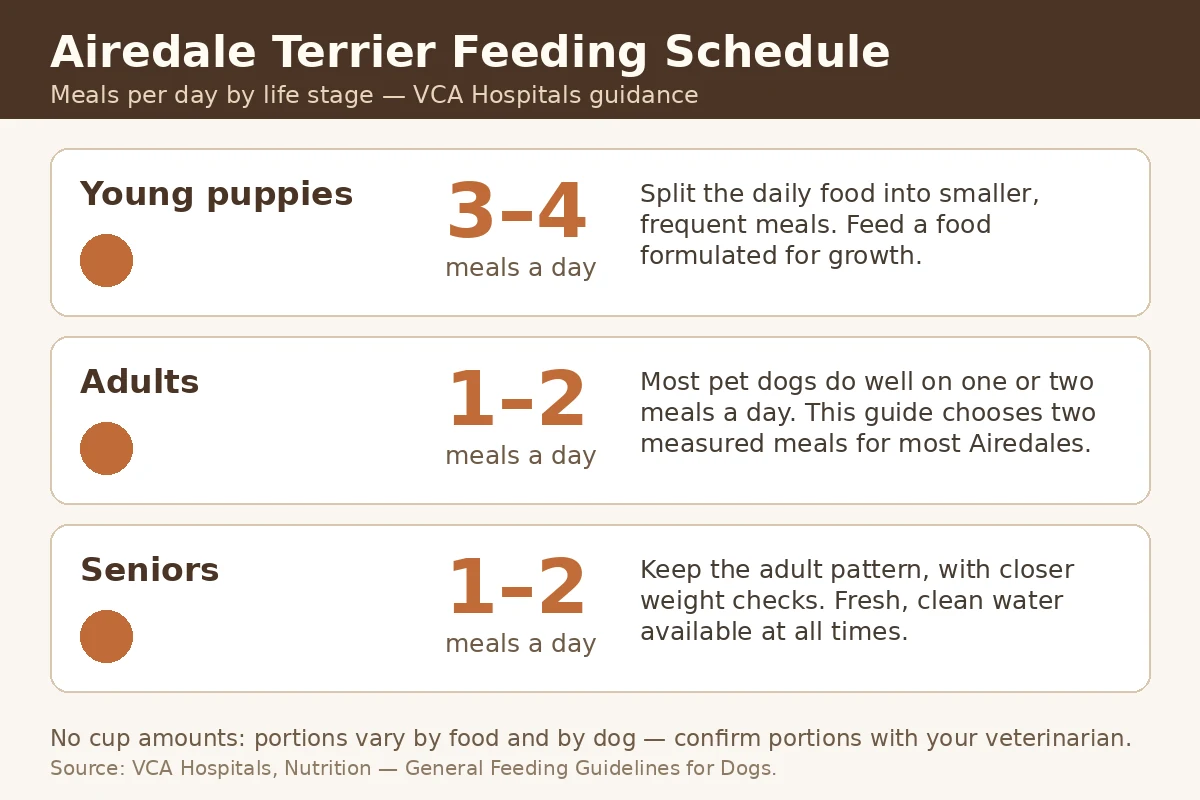
Young puppies need their daily food split into smaller, frequent meals. VCA notes that younger puppies may need the total divided into three or four meals. Puppies have small stomachs and high energy needs during rapid growth. They should eat a food formulated for growth.
Growing puppies stay on frequent meals, then taper as growth slows. Ask your vet when your puppy should change foods; timing varies by dog.
Adults settle into set meals across the day. VCA recommends feeding most pet dogs once or twice per day. It adds that many dogs benefit from equally divided meals two to three times daily.
Two measured meals is the routine I would choose for most adult Airedales. It spreads energy across the day and makes portions easy to track.
Seniors usually keep the adult pattern, with closer weight checks. AAFCO publishes profiles for only two groupings: growth and reproduction, and adult maintenance. So no separate official senior profile sits behind most senior foods. An older dog losing muscle needs a vet conversation, not a new bag.
Keep fresh, clean water available at all times, whatever the age.
Foods to avoid
Some people food causes an upset stomach. Some causes an emergency. The ASPCA list of people foods pets should never eat, via ASPCApro, covers the main dangers:
- Chocolate, coffee, and caffeine — methylxanthines can cause vomiting, tremors, and seizures.
- Grapes and raisins — these can cause kidney failure in dogs.
- Onions, garlic, and chives — they can irritate the gut and damage red blood cells.
- Xylitol — a sweetener in sugar-free gum and candy; it can trigger insulin release and liver failure.
- Macadamia nuts — linked to weakness, vomiting, tremors, and raised temperature.
- Alcohol and raw yeast dough — both can cause serious, fast-moving problems.
- Raw or undercooked meat and eggs — a Salmonella and E. coli risk for dog and owner.
If your Airedale eats something on this list, do not wait for symptoms. Note what he ate and how much. Then call your veterinarian or ASPCA Animal Poison Control straight away.
Your next step: flip your current food over tonight. Find the adequacy statement and the calorie line. Then book a portion check with your vet.
For the dog behind the diet, read our Airedale Terrier behaviour guide. Our Airedale Terrier breed guide covers size, coat, and temperament. Our Airedale Terrier puppies guide covers the first year. Feeding a different breed? Try our Clumber Spaniel diet guide or our Border Terrier diet guide.
FAQ
The best dog food for an Airedale Terrier is a complete, balanced food for your dog’s life stage. Check the adequacy statement against the AAFCO profile for that stage. Then portion by calories and body condition.
There is no single honest cup amount for this breed. Foods differ widely in calories per cup. Start from the package guide for your dog’s weight, then adjust using the rib-and-waist check. Confirm portions with your veterinarian.
Young puppies may need their daily food divided into three or four meals. VCA gives that range for younger puppies. As your puppy grows, meals can taper toward the adult routine. Your vet can confirm the timing for your dog.
Either can be right, and many owners mix both. Dry food is easier to weigh precisely. Wet food adds water and can tempt a reluctant eater. Judge both on the adequacy statement, not the format.
The same foods toxic to dogs generally: chocolate, grapes, raisins, onions, garlic, chives, xylitol, macadamia nuts, alcohol, and caffeine. Even small amounts of grapes or xylitol can do real harm. Call a vet immediately if your dog eats any of them.